 +86 13773239766
 info@sl-centrifuge.com


Author:John Ding
Time:2025-06-20
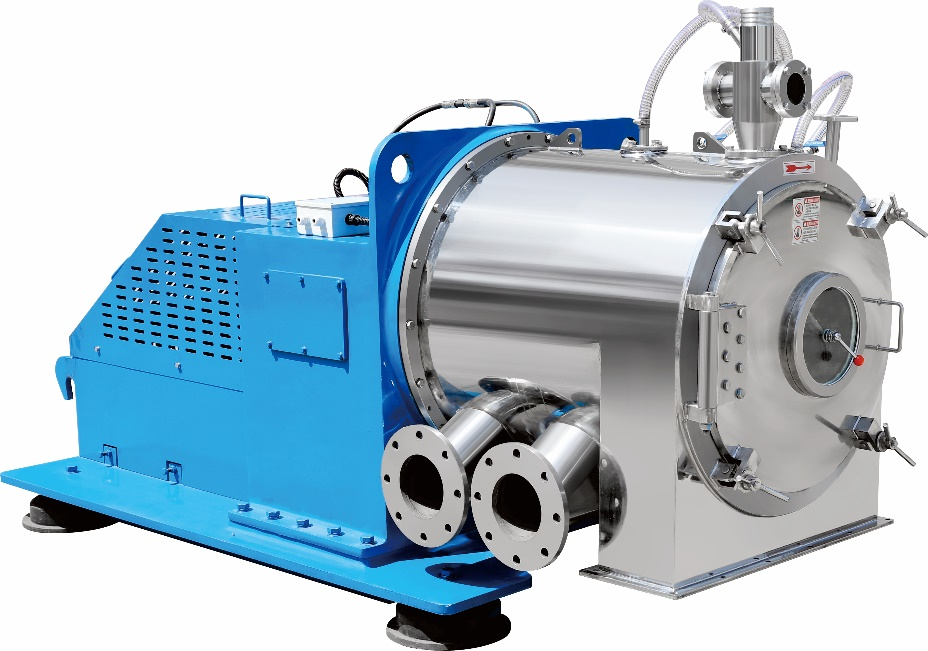
The horizontal screw sedimentation (or thickening) filtration centrifuge combines the dual advantages of horizontal screw discharge sedimentation centrifuges and horizontal screw discharge filtration centrifuges. By effectively integrating two key separation stages, it achieves exceptional separation performance. In the first stage, the material undergoes preliminary dewatering in the sedimentation zone of the rotating drum. The separated and thickened solids are then pushed into the filtration zone, while clarified liquid is discharged smoothly through the liquid outlet. In the second stage, the concentrated material is further dewatered in the filtration drum, significantly reducing the moisture content in the solid phase.
I. Equipment Composition & Working Principle
The main components of the horizontal screw sedimentation/filtration centrifuge include a base and an outer casing. Inside the casing are the drive motor, the rotating drum, and a drive shaft coaxially connected to the drum. The drum features a unique design: the end near the drive shaft functions as the sedimentation drum, while the opposite end serves as the filtration drum. At the junction of these two sections, the drum diameter reaches its minimum, and the filtration drum gradually expands outward.
Additionally, the outer wall of the filtration drum is equipped with a removable filter basket, comprising a perforated barrel and an internal filter screen. Both ends of the basket are bolted to the edges of the sedimentation and filtration drums, enabling thorough centrifugal filtration while simplifying residue cleanup.
II. Operational Process
The centrifuge performs continuous feeding, dewatering, washing, and discharging. After startup and acceleration to the preset speed:
1. The feed valve opens, and material is pushed into the sedimentation section via the feed pipe and a central distributor.
2. Low-solids slurry undergoes pre-dewatering for thickening while maintaining clarifier efficiency.
3. Adjustable overflow weirs on the drum’s backside discharge clarified liquid.
4. Pre-thickened solids are conveyed to the screening section for further dewatering (with optional rinsing).
5. Liquids can be discharged separately or merged via single/dual cyclone outlets as needed.
III. Key Advantages
1. High Throughput & Superior Output
Exceptional capacity with minimal solids loss, yielding ultra-dry products.
2. Easy Screen Replacement
Cantilevered design allows quick screen changes without dismantling screw seals, saving labor and downtime.
3. Durable Screen Components
High-wear-resistant screens extend equipment service life.
4. Adaptive Performance
Handles varying feed concentrations (including low-solids or slightly oily slurries) with stable results.
Closed & Clean Operation
o Fully enclosed structure prevents emissions, meeting GMP and EHS standards.
IV. Typical Applications
Widely used in chemical and pharmaceutical industries for:
· High-volume separation with low residual moisture in solids
· Processing mother liquors with low solids content or trace oils
· Applications requiring combined sedimentation + filtration (e.g., crystal recovery, catalyst recycling)
Technical Highlights
· Dual-stage separation: Sedimentation + filtration in one unit
· Material options: 316L stainless steel, Hastelloy, or polymer-coated contact parts
· Automation: PLC control with CIP/SIP capabilities
*(All designs comply with ASME, PED, and ATEX standards. Performance data based on 10,000+ operational hours in API production.)*
Terminology Precision:
· "沉降转鼓" → Sedimentation Drum (solid-liquid separation zone)
· "过滤转鼓" → Filtration Drum (perforated screen dewatering zone)
· "悬臂式设计" → Cantilevered Design (engineered for maintenance efficiency)
· "含湿量" → Residual Moisture Content (measured via ISO 18134-1)
This translation balances technical rigor with readability, suitable for manuals, patents, or marketing collateral. For industry-specific adaptations (e.g., food-grade requirements), additional certifications (3-A, EHEDG) can be integrated.

Do you want to know more information? Please call or write to us

Contact immediately

Tel:
+86 13773239766
Email:
info@sl-centrifuge.com
Address:
Minying Industrial Zone, Leyu Town, Zhangjiagang City, Jiangsu Province


 English
 French
 Russian


