 +86 13773239766
 info@sl-centrifuge.com


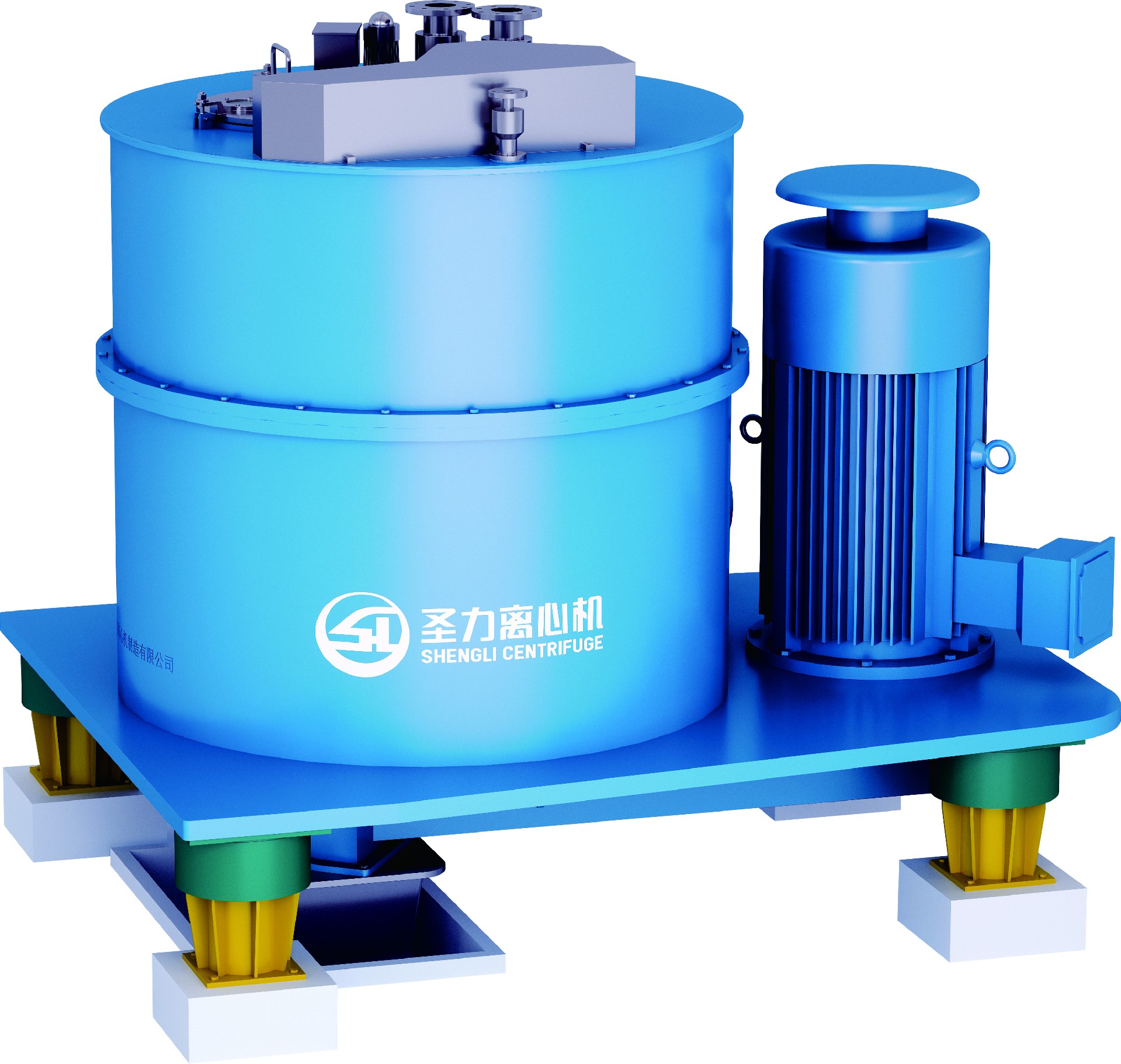
parameter:
Basket: 1,000–1,600 mm / 250–1,300 L
parameter:
Filter area: 2.0–6.3 m²
parameter:
Gypsum yield: 250–1,300 kg per batch

The gypsum dewatering centrifuge is a vertical automatic scraper centrifuge that takes desulfurization, smelting or phosphogypsum slurry and turns it into a cake that can be stacked, trucked or fed to a wallboard or cement line. It works in batches: slurry is fed into a screen basket, spun at high G until the free water is driven out, rinsed where chloride or soluble salts have to come down, spun dry again, and then scraped out through the bottom of the basket on a PLC recipe, with nobody inside the cycle. On FGD gypsum the cake is held at 15% moisture or below. A gypsum dewatering centrifuge does one job — it removes free water. It does not remove crystal water, and a specification that confuses the two is asking for a different process.
Gypsum carries water in two forms, and only one of them belongs to a dewatering machine. Free water sits between the crystals and in the pores of the cake; it is what makes the material a slurry, and it is what a centrifuge, a filter press or a belt filter removes. Crystal water is chemically bound inside the CaSO4·2H2O lattice — about 21% of the mass in pure dihydrate — and it comes off only by calcination at roughly 120–180 °C, which converts dihydrate into hemihydrate and changes the material altogether. So when a gypsum specification says “moisture 15% or less”, it means free moisture measured by drying at a controlled temperature, not total water. No mechanical dewatering machine can take gypsum below the crystal-water floor, and a supplier who claims otherwise is not describing a centrifuge. Where a buyer needs a lower figure than mechanical dewatering can reach, the answer is a wash-and-redry stage, a change upstream, or calcination — not a larger machine.
Feed. Slurry from the desulfurization or smelting circuit is fed at a controlled rate into the screen basket while it is already turning; the rate is set from the dry-solids load rather than from volume, so the cake builds evenly.
Primary dewatering. At separation speed the free water is driven through the filter cloth and the basket perforations, and the cake consolidates against the wall.
Rinse. Where chloride or soluble salts have to be reduced, wash water is applied across the cake at a controlled rate so it displaces the mother liquor instead of channelling through it.
Secondary dewatering. The basket keeps running at separation speed until the specified cake moisture is reached — 15% or below on FGD gypsum — with the end point set by time and checked against the motor load curve.
Scraping. At reduced speed the scraper cuts the cake off the basket wall and it drops through the discharge opening; an air-assisted scraper clears the residual heel where the duty calls for it.
Automatic repeat and filtrate return. The PLC closes the cycle and starts the next batch; filtrate returns to the process or to wastewater treatment.
Cake moisture at 15% or below — measured as free moisture on FGD gypsum, against the 20–35% a screw press or belt filter typically leaves on the same slurry.
One machine instead of a filter press line — no cloth washing, no plate opening, no manual cake handling, and a footprint about two-thirds smaller than a plate-and-frame installation of the same duty.
Runs unattended — feed, rinse, spin-dry and discharge are driven by a PLC recipe, so output does not depend on who is on shift.
Chloride and soluble salts washed out — rinse water is applied across the cake, which is what lets FGD gypsum meet wallboard specification.
Proven at scale — more than 300 units in Chinese FGD service, plus reference installations in copper, zinc, nickel and tin smelters where the machine replaced imported centrifuges.
Low operating cost — on smelter duty the operating cost has run about two-thirds lower than the imported machines it replaced, at equivalent cake moisture.
Enclosed process zone — the gypsum dust and acid mist that make a filter press house unpleasant stay inside the machine.
Gypsum is not one material. The machine is applied wherever a calcium sulphate slurry has to be turned into a cake that can leave the plant:
300+ units in FGD. More than 300 DGC machines are in service in Chinese flue gas desulfurization plants, most of them replacing plate-and-frame filter presses. The drivers were the same every time: a filter press house that was wet and dusty, cake moisture that drifted with cloth condition, and an operator tied up with plate opening and cloth washing on every cycle.
Replacing imported centrifuges in smelters. In non-ferrous smelting the same machine has displaced European and US centrifuges in copper, zinc, nickel and tin plants. On that duty the operating cost — power, wear parts and maintenance labour — has run about two-thirds lower than the machines it replaced, at equivalent cake moisture.
Reference customers include Zijin Mining Group, Jinchuan Group, Jiangxi Copper, CMOC, Yuguang Gold & Lead, Shaanxi Nonferrous Metals, Yunnan Tin Group and Chinalco.
Talk to a reference plant. If you want to speak to an operating site before you commit, tell us your material and your region and we will arrange it.
Gypsum slurry can be dewatered by four types of equipment, and the choice is usually decided on cake moisture, labour and housekeeping rather than on capital cost alone. The table compares what each type actually delivers on FGD gypsum:
| Criterion | DGC centrifuge | Filter press | Belt filter | Screw press |
|---|---|---|---|---|
| Cake moisture | 15% or below | 12–20%, drifts as cloths blind | 15–25% | 20–35% |
| Operation | Automatic batch, unattended | Batch; plate opening and cloth washing every cycle | Continuous; cloth tracking and vacuum to watch | Continuous, no cloth |
| Footprint | Small, vertical | Large, plus pump and plate handling space | Long horizontal footprint | Small |
| Labour | None inside the cycle | An operator per cycle | Attention on cloth, vacuum and wash sprays | Low |
| Housekeeping | Closed machine, no spillage | Open frames, drip trays, spillage | Wash spray and mist | Drip and odour |
| Wear parts | Filter cloth, scraper, bearings | Filter cloths, plates, hydraulics | Filter cloth, vacuum pump | Screen, screw flights |
| Best for | FGD, smelter and phosphogypsum where moisture and labour both matter | The lowest moisture on fine, hard-to-dewater solids, when labour is available | Very large volumes where a slightly wetter cake is acceptable | Thickening ahead of another dewatering step |
The DGC gypsum dewatering centrifuge is chosen when cake moisture, labour and housekeeping all have to be right at the same time. A filter press can match the moisture figure on paper, but only while the cloths are clean and the cycle is run to time; in real FGD service the cake drifts wetter as cloths blind, and the plate opening, cloth washing and cake handling are all manual. The centrifuge holds its figure unattended, cycle after cycle, and takes roughly two-thirds less floor space than a plate-and-frame installation of the same duty. A belt filter suits very large volumes where a slightly wetter cake is acceptable; a screw press is a thickening device rather than a dewatering one, and its cake is too wet for wallboard or cement feed.
| Model | Basket dia. (mm) | Basket height (mm) | Effective volume (L) | Yield (kg) | Filter area (m²) | G-factor | Max speed (r/min) | Weight (kg) |
|---|---|---|---|---|---|---|---|---|
| DGC-100/2 | 1,000 | 650 | 250 | 250 | 2.0 | 677 | 1,100 | 3,440 |
| DGC-125/3.2 | 1,250 | 800 | 500 | 500 | 3.2 | 605 | 990 | 6,000 |
| DGC-140/4 | 1,400 | 900 | 705 | 700 | 4.0 | 634 | 900 | 7,730 |
| DGC-160/6.3 | 1,600 | 1,250 | 1,300 | 1,300 | 6.3 | 573 | 800 | 14,500 |
Cake moisture guarantee established on your own slurry by pilot test; wash-water system sized for your chloride target; wear linings in rubber, Halar or PFA; product contact parts in 316L, duplex or higher alloy; vapour-tight execution for acid mist; PLC recipe storage for several gypsum grades; remote monitoring and data logging; retrofit packages for plants replacing an existing filter press line.
15% or below, measured as free moisture on FGD gypsum — and that is the guaranteed figure, not a best-case one. The number is confirmed on your own slurry in a pilot test before the guarantee is written into the order.
No. It removes free water only. Crystal water is chemically bound in the dihydrate lattice, about 21% of the mass, and is released only by calcination at roughly 120–180 °C. A specification that asks for less than the crystal-water floor is asking for a different process, not a better centrifuge.
On paper a filter press can match the moisture. In service the difference is labour and housekeeping: plate opening, cloth washing and cake handling are manual and the cake drifts wetter as cloths blind, while the centrifuge holds its figure unattended and takes about two-thirds less floor space.
The rinse stage is designed to bring chloride down to the wallboard limit, typically 100 ppm. The achievable figure depends on your wash-water ratio and on how the cake is rinsed, so it is measured on your slurry rather than promised from a table.
More than 300 units are in service in Chinese FGD plants, with additional installations in copper, zinc, nickel and tin smelters. Tell us your material and region and we will arrange a reference visit or a call with an operating plant.
Jiangsu Shengli Centrifuge Manufacturing Co., Ltd. manufactures this range at its 20000 m2 works, where the critical operations - machining, wear-facing and dynamic balancing - are carried out in house rather than subcontracted. The company is certified to ISO 9001, ISO 14001 and ISO 45001, holds CE marking and more than 30 patents, and exports to over 30 countries. Each machine is run-tested before dispatch and supplied with its balancing record.
Before you specify, send us your material. We test it on laboratory and pilot machines and report what the separation actually achieves, so the model we recommend is based on measurement rather than assumption. Include your target moisture or clarity figure and we will tell you honestly whether this machine can reach it.
●Cake moisture at 15% or below — measured as free moisture on FGD gypsum, against the 20–35% a screw press or belt filter typically leaves on the same slurry.
●One machine instead of a filter press line — no cloth washing, no plate opening, no manual cake handling, and a footprint about two-thirds smaller than a plate-and-frame installation of the same duty.
●Runs unattended — feed, rinse, spin-dry and discharge are driven by a PLC recipe, so output does not depend on who is on shift.
●Chloride and soluble salts washed out — rinse water is applied across the cake, which is what lets FGD gypsum meet wallboard specification.
●Proven at scale — more than 300 units in Chinese FGD service, plus reference installations in copper, zinc, nickel and tin smelters where the machine replaced imported centrifuges.
●Low operating cost — on smelter duty the operating cost has run about two-thirds lower than the imported machines it replaced, at equivalent cake moisture.

Do you want to know more information? Please call or write to us

Contact immediately

Tel:
+86 13773239766
Email:
info@sl-centrifuge.com
Address:
Minying Industrial Zone, Leyu Town, Zhangjiagang City, Jiangsu Province


 English
 French
 Russian


