 +86 13773239766
 info@sl-centrifuge.com

parameter:
Bowl: 350–650 mm
parameter:
Main motor: 15–90 kW
parameter:
Capacity: 2–60 m³/h

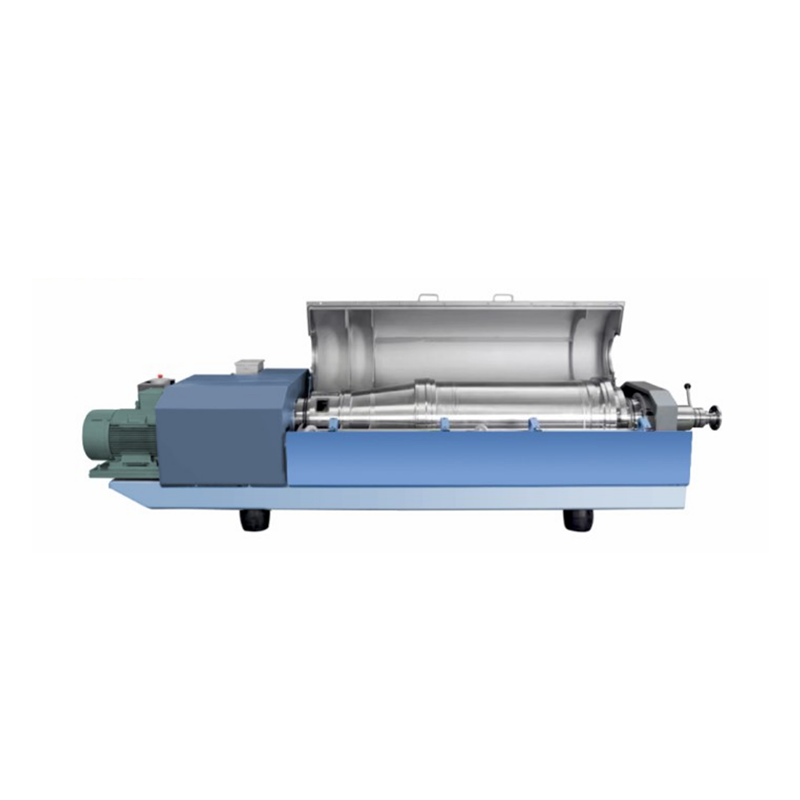
A three-phase decanter centrifuge — also called a tricanter — separates a mixture into three streams at once: a heavy liquid, a light liquid and a solid. Where a two-phase decanter only splits solids from liquid, the tricanter uses a deeper pond and a second discharge path so that two immiscible liquids can be drawn off at different radii while the scroll conveys the solids out of the cone. In one pass it replaces what would otherwise be a two-phase centrifuge followed by coalescing and skimming. A three-phase decanter centrifuge is therefore the machine of choice wherever oil must be recovered from a water-and-solids stream rather than simply disposed of with it.
1) Feed. The three-phase mixture is fed into the bowl and accelerated to full speed. 2) Separation. Centrifugal force sorts the contents by density: solids collect at the bowl wall, the heavier liquid forms the layer against them and the lighter liquid forms an inner ring on its surface. 3) Heavy-phase discharge. The denser liquid leaves through a centripetal pump or an overflow plate at the cylindrical end. 4) Light-phase discharge. The lighter liquid — oil, fat or solvent — is pushed along the surface of the heavy phase and leaves through the overflow channel. 5) Solids conveying and discharge. The scroll moves the solids up the conical beach and discharges them dewatered. 6) Boundary control. The position of the liquid-liquid interface decides the purity of both liquid streams, so the discharge arrangement is set from your test results and then locked into the operating recipe.
Three streams in one pass — oil, water and solids are separated by a single machine instead of a multi-stage process.
No coalescer or skim tank — removing the intermediate step cuts equipment, piping, floor space and the associated maintenance.
Recovered oil is an income stream — instead of paying to treat an oily waste, you recover a phase you can sell or reprocess.
Controlled liquid-liquid boundary — the interface position sets the purity of both liquid streams and is fixed from your own test results, not guessed at commissioning.
Handles high solids loads — the scroll removes solids continuously, so the machine does not depend on settling in a tank.
Closed and safe — vapor-tight and nitrogen-blanketed execution available for hydrocarbon and solvent duty.
A three-phase decanter centrifuge is used wherever liquid waste contains oil worth recovering — or where the oil phase must be separated before the water can be discharged:
A tricanter usually replaces a combination of other equipment. Compare the process routes before you invest in the second machine:
| Criteria | LWS three-phase decanter | Two-phase decanter plus coalescer | Skim tank plus filter |
|---|---|---|---|
| Streams separated | Oil, water, solids in one pass | Solids first, then oil-water split | Solids settled, oil skimmed |
| Oil recovery | High | Medium | Low |
| Equipment count | One machine | Two or three units plus piping | Tank, skimmer, filter |
| Footprint | Small | Large | Large |
| Continuous duty | Yes | Partly batch | Batch |
| Best suited to | Oily sludge and edible oil streams | Moderate oil content | Low oil, low value waste |
Choose the LWS three-phase decanter centrifuge when oil content is high enough to be worth recovering and continuous duty matters. Where the oil fraction is small and of no value, a two-phase decanter is simpler and cheaper to operate — we will tell you which case yours is.
| Model | Bowl dia. (mm) | Max speed (r/min) | Max G | Capacity (m³/h) | Main motor (kW) | Weight (kg) |
|---|---|---|---|---|---|---|
| LWS350 | 350 | 4,000 | 3,130 | 2–6 | 15 | 1,450 |
| LWS450 | 450 | 3,500 | 3,085 | 6–15 | 30–37 | 2,600 |
| LWS530 | 530 | 3,200 | 3,038 | 12–30 | 45–55 | 3,800 |
| LWS650 | 650 | 2,800 | 2,850 | 25–60 | 75–90 | 6,500 |
Bowl and scroll in 316L, duplex 2205 or higher; centripetal pump or overflow-plate discharge for the heavy phase, with the interface position set at commissioning; vapor-tight casing and nitrogen blanketing for hydrocarbon duty; explosion-proof motor and panel; variable-frequency drive with automatic differential-speed control; heating or insulation for waxy or fat-rich feeds; skid package with feed pump, dosing and PLC.
Broadly, when the oil you can recover is worth more than the cost and complexity of the extra separation stage — which is usually true once oil is clearly present as a separate phase in the feed. The honest way to decide is a test: send a sample and we will measure the three stream purities on a pilot machine before you commit.
By the position of the liquid-liquid interface inside the bowl. The heavy phase leaves through a centripetal pump or an overflow plate, the light phase over the overflow channel, and the balance between the two sets where the interface sits and therefore how pure each stream is. The correct setting is established from your test results and then locked into the operating recipe.
Partially. A tricanter works best when the oil is present as a distinct phase. Heavily emulsified or chemically stabilized oil is harder to split mechanically and may need pre-treatment, such as demulsifier dosing or gentle heating, which we can build into the skid.
Often yes. Animal fat, palm oil and waxy refinery sludge separate better when the feed is held above its melting point, so the machine can be supplied insulated and the skid fitted with a heater. That keeps the feed flowing and the light phase liquid.
One is usually enough, because the separation is continuous. Capacity depends on the solids load far more than on the liquid flow: the scroll has to remove the solids as fast as they arrive. Tell us your solids content and we will size the bowl accordingly.
Behind this machine is Jiangsu Shengli Centrifuge Manufacturing Co., Ltd.: a 158,905 m2 manufacturing plant, ISO 9001, ISO 14001 and ISO 45001 certification, CE marking, more than 30 patents and installations in over 30 countries. Rotor balancing, wear-facing and final testing are done in house, so the machine that arrives on site is the machine that was measured on the balancing machine, and the report to prove it travels with it.
Talk to our engineers with your material data in hand. Send a sample, tell us the throughput you need and the specification you have to meet, and we will come back with a measured result, a recommended model and the operating settings that produced it - not simply the largest machine in the range.
●Three streams in one pass — oil, water and solids are separated by a single machine instead of a multi-stage process.
●No coalescer or skim tank — removing the intermediate step cuts equipment, piping, floor space and the associated maintenance.
●Recovered oil is an income stream — instead of paying to treat an oily waste, you recover a phase you can sell or reprocess.
●Controlled liquid-liquid boundary — the interface position sets the purity of both liquid streams and is fixed from your own test results, not guessed at commissioning.
●Handles high solids loads — the scroll removes solids continuously, so the machine does not depend on settling in a tank.
●Closed and safe — vapor-tight and nitrogen-blanketed execution available for hydrocarbon and solvent duty.

Do you want to know more information? Please call or write to us

Contact immediately

Tel:
+86 13773239766
Email:
info@sl-centrifuge.com
Address:
Minying Industrial Zone, Leyu Town, Zhangjiagang City, Jiangsu Province


 English
 French
 Russian


