 +86 13773239766
 info@sl-centrifuge.com


parameter:
Bowl: 220–650 mm
parameter:
Main motor: 5.5–90 kW
parameter:
Capacity: 1–80 m³/h

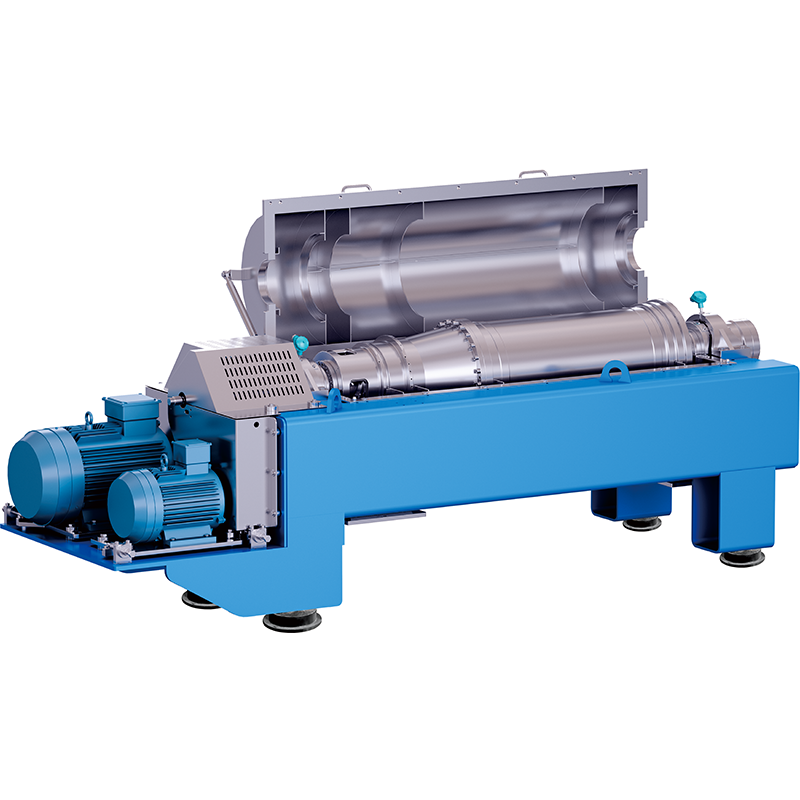
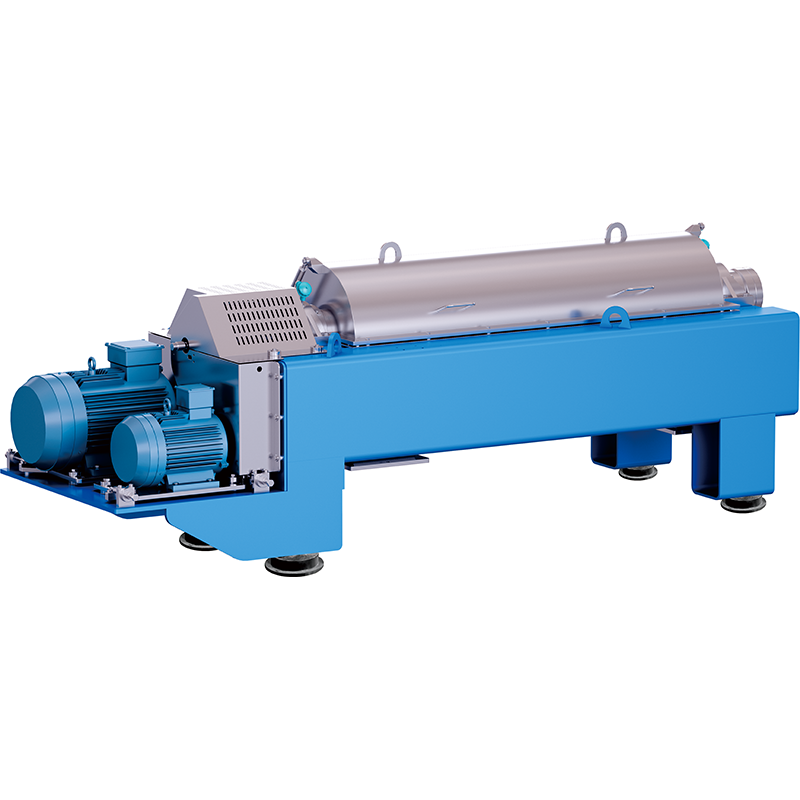
The LW decanter centrifuge is a horizontal solid-bowl scroll centrifuge that separates suspended solids from liquids continuously under full centrifugal force, with no batch cycle and no stopping for discharge. Slurry is pumped through a feed tube into a rotating bowl, clarified liquid overflows at the cylindrical end, and dewatered solids are conveyed out of the conical end by a scroll rotating at a slightly different speed. Because there is no filter cloth, an LW decanter centrifuge keeps working on fine particles, oily sludge and feeds whose solids content fluctuates — the three conditions that blind a filter press and stall a screw press. The LW range covers particles from about 5 µm at solids concentrations of 2–40%, with length-to-diameter ratios from 2:1 to 4.4:1 matched to how fine your solids are.
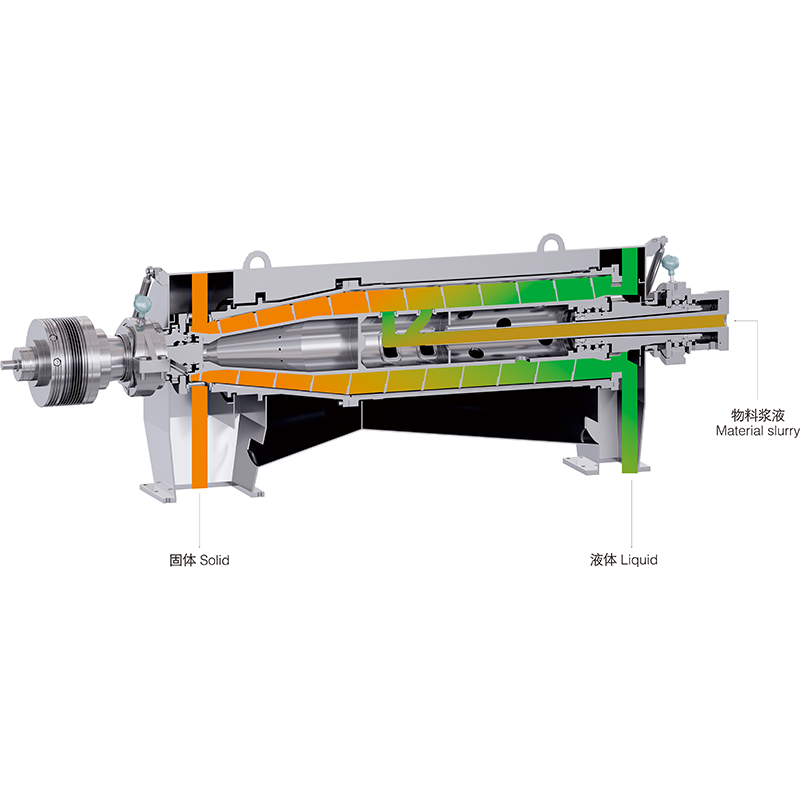
1) Feed and acceleration. Slurry enters a stationary feed tube, passes into the scroll hub and is accelerated to bowl speed inside the pond. 2) Sedimentation. Centrifugal force of 1,800 to 4,000 G, depending on bowl diameter, drives the solids to the bowl wall within seconds; the settling area is long and shallow for maximum capture of fine particles. 3) Conveying. The scroll turns slightly faster or slower than the bowl. That difference — the differential speed — pushes settled solids along the bowl wall toward the conical end. 4) Discharge. Dry cake exits the conical beach through the solids outlet; clarified liquid leaves over an adjustable weir at the cylindrical end. 5) Control. The differential gearbox sets conveying speed, and automatic differential-speed control adjusts it to the actual scroll torque, so cake dryness stays stable when the feed changes.
Steady cake dryness under varying feed — torque-sensing automatic differential-speed control, not a fixed gear ratio.
Wear protection where it matters — tungsten-carbide tiles on the scroll flight and solids outlet, hard-facing on the beach; field-replaceable without a new scroll.
True continuous duty — 24/7 operation with no batch cycle, no cloth washing and minimal operator attention.
Adjustable pool depth — move the liquid weir to trade cake dryness against supernatant clarity for your specific material.
Enclosed and safe — fully enclosed execution, optional vapor-tight and explosion-proof versions for solvent and hydrocarbon duty.
Corrosion-resistant options — duplex 2205, 316L and higher alloys for acidic and chloride-bearing slurries.
Long length-to-diameter options — bowls from 2:1 to 4.4:1, so the settling area is matched to how fine your solids are rather than to a single standard geometry.
An LW decanter centrifuge is specified wherever a slurry must be split continuously and the solids will not respond to a filter cloth:
Decanter, filter press or screw press — the choice comes down to continuity, fines and labor:
| Criteria | LW decanter centrifuge | Filter press | Screw press |
|---|---|---|---|
| Operation | Fully continuous | Batch | Continuous |
| Fine particles | Good — no cloth to blind | Poor — cloth blinds | Poor — washes out |
| Cake dryness | High (with auto differential) | Highest | Moderate |
| Filtrate clarity | Good, adjustable by weir | Excellent | Weak |
| Footprint | Small | Large | Small |
| Labor | Low — automated | High — cloth washing | Low |
| Wash water | Low | High | Medium |
Choose an LW decanter centrifuge when you need continuous duty, reliable capture of fine solids, low labor and an enclosed process. Choose a filter press only when maximum dryness or a near-clear filtrate justifies a batch cycle and the labor it brings.
| Model | Bowl dia. (mm) | Max speed (r/min) | Max G | Capacity (m³/h) | Main motor (kW) | Weight (kg) |
|---|---|---|---|---|---|---|
| LW220 | 220 | 5,000 | 3,075 | 1–3 | 5.5 | 480 |
| LW350 | 350 | 4,000 | 3,130 | 3–8 | 15 | 1,250 |
| LW430 | 430 | 3,600 | 3,120 | 6–15 | 22–30 | 2,050 |
| LW450 | 450 | 3,500 | 3,085 | 8–20 | 30–37 | 2,450 |
| LW530 | 530 | 3,200 | 3,038 | 15–40 | 45–55 | 3,600 |
| LW650 | 650 | 2,800 | 2,850 | 30–80 | 75–90 | 6,200 |
Bowl and scroll in 304, 316L or duplex 2205; ceramic or tungsten-carbide wear tiles; vapor-tight or nitrogen-blanketed execution; explosion-proof motor and control panel; variable-frequency drive with automatic differential-speed control; skid-mounted package with pump, dosing unit and PLC; open or closed cake discharge.
Dryness depends on the material, not on the machine alone. As a guide, municipal sludge normally reaches 18–25% dry solids, mineral slurries 60–75%, and crystalline salts above 90%. Send us a sample and we will measure the actual figure on a pilot unit.
The controller reads scroll torque and adjusts the differential speed in real time. When the feed thickens, it slows conveying to build a drier cake; when the bowl risks plugging, it speeds up and clears it. Cake dryness stays stable without an operator touching the machine.
Change the oil after the first 2,000 hours, then at 2,000 hours again for the second change; after that, 4,000–8,000 hours depending on load and oil analysis. Check the oil seal and bearing temperature at every service.
Yes. Decanter centrifuges are designed for continuous duty; you stop only for routine washing, inspection and lubrication. Automatic differential-speed control and online vibration monitoring are what make unattended operation practical.
For FGD gypsum at scale, a decanter usually wins: it runs continuously, tolerates fine particles, needs far less wash water and can be fully enclosed. A filter press still gives higher dryness where that single parameter outweighs the batch cycle and labor.
Jiangsu Shengli Centrifuge Manufacturing Co., Ltd. builds this equipment in a 158,905 m2 plant with in-house machining, hard-facing and rotor dynamic balancing. The company holds ISO 9001, ISO 14001 and ISO 45001 certification, CE marking and more than 30 patents, and has supplied machines to customers in over 30 countries. Every unit is balanced and run-tested before shipment, and the balancing report is supplied with the machine.
Send us a sample of your material and we will run it on a pilot machine, then report the measured moisture, throughput and clarity before you order. Tell us your material and your target, and our engineers will recommend the model, the material of construction and the options that fit.
●Steady cake dryness under varying feed — torque-sensing automatic differential-speed control, not a fixed gear ratio.
●Wear protection where it matters — tungsten-carbide tiles on the scroll flight and solids outlet, hard-facing on the beach; field-replaceable without a new scroll.
●True continuous duty — 24/7 operation with no batch cycle, no cloth washing and minimal operator attention.
●Adjustable pool depth — move the liquid weir to trade cake dryness against supernatant clarity for your specific material.
●Enclosed and safe — fully enclosed execution, optional vapor-tight and explosion-proof versions for solvent and hydrocarbon duty.
●Corrosion-resistant options — duplex 2205, 316L and higher alloys for acidic and chloride-bearing slurries.

Do you want to know more information? Please call or write to us

Contact immediately

Tel:
+86 13773239766
Email:
info@sl-centrifuge.com
Address:
Minying Industrial Zone, Leyu Town, Zhangjiagang City, Jiangsu Province


 English
 French
 Russian


