 +86 13773239766
 info@sl-centrifuge.com


parameter:
Two-stage basket: 400–800 mm
parameter:
Motor: 15–90 kW
parameter:
Capacity: 1–50 t/h dry solids

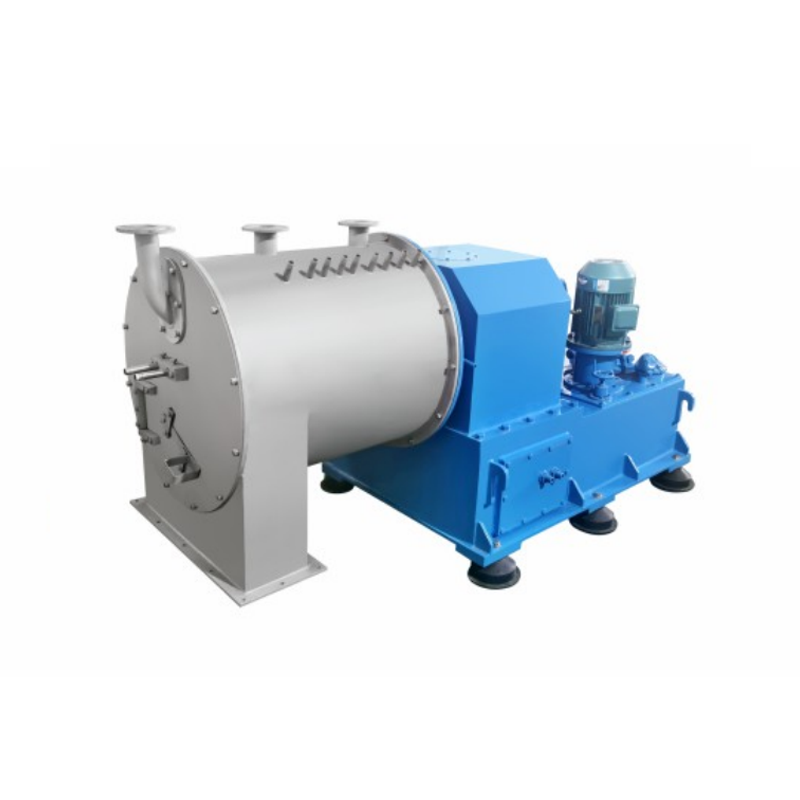
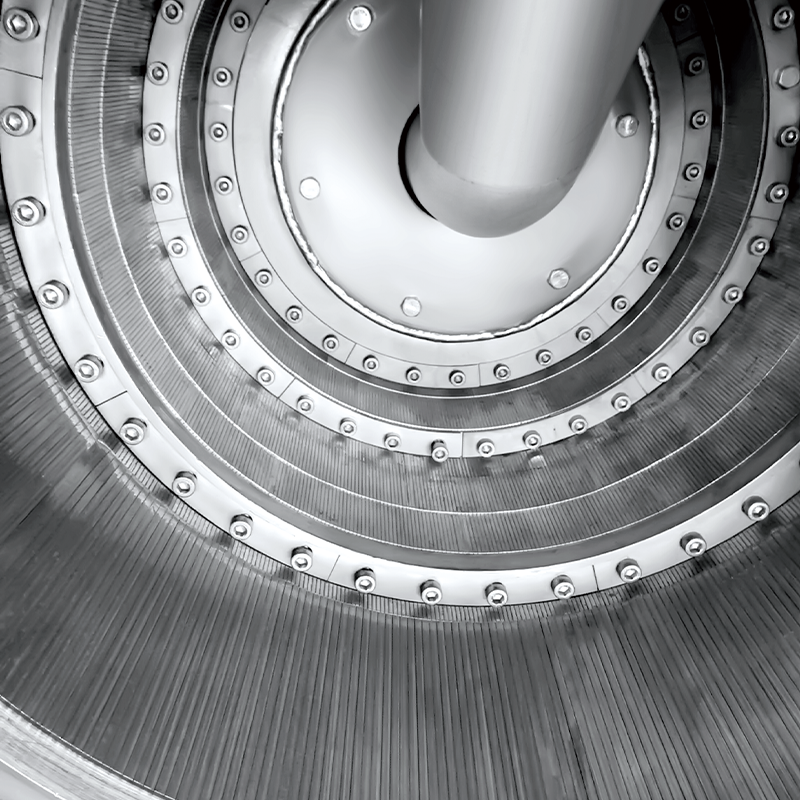
A pusher centrifuge is a continuous filtering centrifuge in which a reciprocating pusher plate shoves the growing cake along a slotted basket in short strokes. Slurry is fed onto the first basket, liquid drains through the slots under centrifugal force, and each stroke of the pusher advances the crystal layer into the next stage, where it is washed again and dewatered further before discharging over the basket rim. On the HR the process happens in two stages, so the cake is turned and re-washed partway through — that is what gives a pusher centrifuge its low residual moisture and its clean mother liquor, and why salt and fertilizer plants run it continuously at high tonnage.
1) Feed. Slurry is distributed onto the first-stage basket, where a thin cake forms immediately. 2) First-stage filtration. Liquid drains through the basket slots; the crystal layer acts as its own filter medium. 3) First push and wash. The pusher plate advances, moving the layer into the second stage where wash liquid is applied. 4) Second-stage dewatering. The cake is dewatered again on a fresh section of basket, with the layer inverted so the liquor trapped underneath is exposed and displaced. 5) Discharge. The final push ejects the cake over the basket rim into a chute. 6) Continuous repeat. Strokes continue at a fixed frequency, so feed, wash and discharge never stop.
Low residual moisture — the two-stage push inverts the cake so trapped mother liquor is exposed and washed out instead of staying inside the crystal bed.
Clean mother liquor — effective counter-current washing gives a filtrate low in the solids that would otherwise contaminate the recycle.
True continuous duty — the basket never stops; strokes run at a set frequency, so output is steady and predictable.
High single-machine capacity — throughput scales with basket diameter, and the largest frames handle tens of tonnes of dry solids per hour.
Coarse-crystal friendly — best performance on uniform, free-draining crystals, which is exactly what a well-run crystallizer produces.
Wear-resistant by design — slotted basket, pusher plate and wear ring in hardened or carbide-faced materials for salt abrasion.
The HR pusher centrifuge is the standard continuous machine in salt plants, chlor-alkali works and fertilizer complexes, where a steady stream of coarse crystals must be dewatered around the clock:
Continuous filtering machines move the cake in different ways, and that difference decides which one suits your crystal:
| Criteria | HR two-stage pusher | LWL screen scroll | GK scraper |
|---|---|---|---|
| Cake movement | Reciprocating pusher plate | Low-speed scroll | Scraper, batch |
| Operation | Continuous, pulsed | Continuous | Batch, full speed |
| Best on | Coarse, uniform crystals | Crystals plus some fines | Fine solids |
| Moisture | Very low with two-stage wash | Low | Moderate |
| Wash quality | Excellent — counter-current | Good — multi-stage | Single stage |
| Fines tolerance | Low — fines blind the slots | Moderate | Good |
Choose the HR pusher centrifuge when your crystallizer produces coarse, uniform crystals and you want the lowest moisture with the cleanest mother liquor. If your solids contain a significant fines fraction, a screen scroll machine will run more reliably; if they are fine, a scraper machine is the right answer.
| Model | Stage 1 basket (mm) | Stage 2 basket (mm) | Max speed (r/min) | Max G | Capacity (t/h dry) | Motor (kW) |
|---|---|---|---|---|---|---|
| HR400 | 400 | 480 | 2,000 | 1,075 | 1–5 | 15–22 |
| HR500 | 500 | 600 | 1,800 | 1,090 | 4–12 | 30–37 |
| HR630 | 630 | 760 | 1,500 | 1,065 | 10–25 | 45–55 |
| HR800 | 800 | 960 | 1,200 | 1,008 | 20–50 | 75–90 |
Basket and pusher plate in 316L, duplex or higher; slotted basket with hardened or carbide-facing; wear rings and screens as replaceable consumables; counter-current wash headers; vapor-tight or explosion-proof execution; variable-frequency drive with stroke-rate control; PLC with load and moisture control; chute and discharge design to suit your conveyor.
It inverts the cake. In a single-stage machine the liquor trapped between crystals has nowhere to go, so residual moisture and mother liquor stay in the product. In the two-stage machine the layer is pushed onto a fresh section of basket and turned over, so that trapped liquor is exposed, washed out and drained. The result is a measurably drier cake and a cleaner filtrate.
The HR is applied to suspensions with particles above about 0.08 mm and a solids concentration above roughly 35%, and it performs best when those crystals are coarse and uniform. If the feed carries a large fines fraction, those fines blind the basket slots and the machine will need frequent washing. Send us a screen analysis and we will tell you honestly whether a pusher or a screen scroll machine suits your product.
For coarse vacuum salt, moisture is typically 2–4% after two-stage washing. Exact figures depend on crystal size distribution and on how much wash you can accept, and are confirmed on a test machine.
Yes. The wash section filtrate can be collected separately from the main filtrate, so a concentrated mother-liquor stream is recovered for return to the crystallizer rather than being diluted into the whole filtrate volume.
The basket slots and the pusher plate edges, because salt is abrasive. Both are designed as replaceable items and we hold them as stock parts. Stroke frequency and feed rate also affect wear, so the operating recipe matters as much as the metallurgy.
Behind this machine is Jiangsu Shengli Centrifuge Manufacturing Co., Ltd.: a 158,905 m2 manufacturing plant, ISO 9001, ISO 14001 and ISO 45001 certification, CE marking, more than 30 patents and installations in over 30 countries. Rotor balancing, wear-facing and final testing are done in house, so the machine that arrives on site is the machine that was measured on the balancing machine, and the report to prove it travels with it.
Talk to our engineers with your material data in hand. Send a sample, tell us the throughput you need and the specification you have to meet, and we will come back with a measured result, a recommended model and the operating settings that produced it - not simply the largest machine in the range.
●Low residual moisture — the two-stage push inverts the cake so trapped mother liquor is exposed and washed out instead of staying inside the crystal bed.
●Clean mother liquor — effective counter-current washing gives a filtrate low in the solids that would otherwise contaminate the recycle.
●True continuous duty — the basket never stops; strokes run at a set frequency, so output is steady and predictable.
●High single-machine capacity — throughput scales with basket diameter, and the largest frames handle tens of tonnes of dry solids per hour.
●Coarse-crystal friendly — best performance on uniform, free-draining crystals, which is exactly what a well-run crystallizer produces.
●Wear-resistant by design — slotted basket, pusher plate and wear ring in hardened or carbide-faced materials for salt abrasion.

Do you want to know more information? Please call or write to us

Contact immediately

Tel:
+86 13773239766
Email:
info@sl-centrifuge.com
Address:
Minying Industrial Zone, Leyu Town, Zhangjiagang City, Jiangsu Province


 English
 French
 Russian


