 +86 13773239766
 info@sl-centrifuge.com


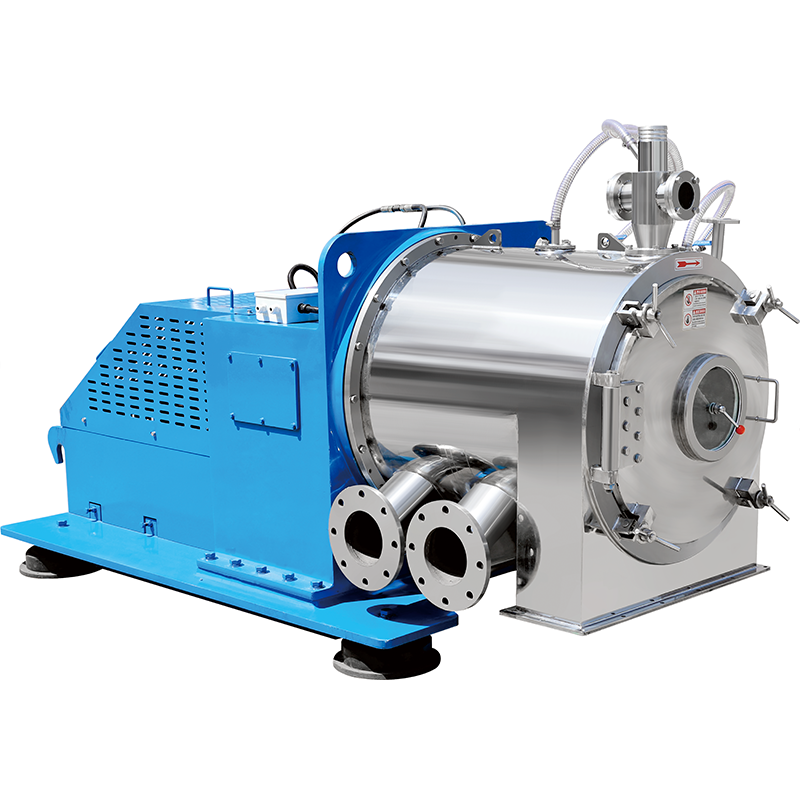
parameter:
Bowl: 350–630 × 1,300–2,500 mm
parameter:
Motor: 15–90 kW
parameter:
Capacity: 3–60 m³/h

The concentration filtration centrifuge is a horizontal scroll machine with a settling section in front of the screen. Dilute feed carrying fine or slimy solids is first thickened against the drum wall, so by the time the solids reach the screen there is far less liquid to drain and the screen is not blinded by a thin, sticky layer. It is built on the LWL screen scroll platform with a concentration device added, and it exists for one reason: feeds that are too dilute, or too rich in fine and viscous solids, for a plain filtering centrifuge to dewater well. That makes a concentration filtration centrifuge the practical choice where a screen on its own would blind within minutes.
1) Feed. Slurry enters the settling section of the drum, where the pool is deep and the settling path is long. 2) Concentration. Centrifugal force drives the solids to the drum wall and the scroll conveys them forward, so a thickened underflow reaches the screen while a clarified overflow leaves at the cylindrical end. 3) Transfer to the screen. The concentrated solids move onto the filtering section already carrying far less liquid. 4) Filtration and washing. The screen drains the remaining liquid and wash water can be applied to displace mother liquor. 5) Discharge. Dewatered solids leave continuously at the conical end. 6) Filtrate split. Clarified overflow and screen filtrate are collected separately, so a clean stream can be returned to the process instead of going to treatment.
Concentration before filtration — a settling section thickens the feed first, so the screen sees a concentrated solids load instead of a dilute stream.
Built on the LWL platform — the screen scroll machine is proven on crystalline duty, and the concentration section is the addition that extends it to dilute and slimy feeds.
Fine and viscous solids handled — material that would blind a plain filter is concentrated first and then drained on the screen.
Good fines recovery — settling captures particles that would otherwise pass the screen and return to the process.
Separated liquor streams — clarified overflow and screen filtrate can be collected independently.
Corrosion and wear options — drum and scroll in duplex 2205 or titanium TA2, with tungsten-carbide flight protection.
Use an LWLC concentration filtration centrifuge when the feed is too dilute, or carries too many fine and slimy solids, for a plain filtering centrifuge to dewater reliably:
The two combined machines share a platform but do different jobs. Pick from what your feed actually contains:
| Criteria | LWLC concentration + filtration | LWZ sedimentation + filtration | Plain decanter |
|---|---|---|---|
| Feed condition | Dilute, with fine or slimy solids | Moderately concentrated, dryness target | Wide range, clarity first |
| First stage | Concentration (settling) | Sedimentation | Sedimentation |
| Second stage | Screen filtration | Screen filtration | None |
| Liquid clarity | Clarified overflow separate from screen filtrate | Clarified overflow separate from screen filtrate | Single centrate |
| Cake dryness | Medium to high | High — screen section adds dewatering | Medium |
| Best suited to | Dilute or slimy feeds that blind a filter | Feeds needing a drier cake | High solids, clarity tolerant |
Choose the LWLC concentration filtration centrifuge when the feed is dilute or carries fine, slimy solids that would blind a screen, and you need a clean overflow as well as a handleable cake. Where the feed is already concentrated and cake dryness is the only target, an LWZ or a plain decanter does the job with less complexity.
| Model | Drum dia. (mm) | Drum length (mm) | Max speed (r/min) | Max G | Capacity (m³/h) | Motor (kW) |
|---|---|---|---|---|---|---|
| LWLC350 | 350 | 1,300 | 3,500 | 2,395 | 3–8 | 15–22 |
| LWLC450 | 450 | 1,800 | 3,200 | 2,577 | 8–20 | 30–37 |
| LWLC530 | 530 | 2,100 | 2,900 | 2,494 | 15–35 | 45–55 |
| LWLC630 | 630 | 2,500 | 2,600 | 2,382 | 25–60 | 75–90 |
Drum and scroll in 316L, duplex 2205, super duplex or titanium TA2; tungsten-carbide wear tiles on the scroll flight; separate filtrate compartments; multi-stage wash; variable-frequency drive with automatic differential-speed control; vapor-tight or explosion-proof execution; PLC with clarity and torque monitoring; remote diagnostics.
The concentration section exists precisely for dilute feed: the solids are thickened against the drum wall before the screen ever sees them, so a feed carrying only a small percentage of solids can still be dewatered. Tell us the lowest and highest solids content you expect, and we size the settling length and pool depth accordingly.
They are two very different liquids. The overflow is clarified liquor that may be recyclable or cheap to discharge; the screen filtrate is wash liquid carrying the displaced mother liquor. Keeping them apart lets you send only the small dirty stream to treatment instead of the whole volume.
Duplex 2205 handles chloride-bearing liquor and mildly acidic service very cost-effectively. For strongly acidic, oxidizing or chloride-saturated liquors — titanium dioxide and some leaching circuits, for example — titanium TA2 is the more reliable choice. We decide from a liquor analysis, not from a guess.
Yes, and that is the main reason to buy it. Automatic differential-speed control reads the scroll torque and adjusts conveying to the actual load, so the machine keeps producing a stable cake even when solids content, particle size or flow rate change.
The wear parts are the same family — scroll flight tiles, solids outlet, bearings and seals — with the additions of a filter screen and its fixings. Screen and tile condition are checked at planned intervals and both are supplied as stock items.
Jiangsu Shengli Centrifuge Manufacturing Co., Ltd. manufactures this range at its 158,905 m2 works, where the critical operations - machining, wear-facing and dynamic balancing - are carried out in house rather than subcontracted. The company is certified to ISO 9001, ISO 14001 and ISO 45001, holds CE marking and more than 30 patents, and exports to over 30 countries. Each machine is run-tested before dispatch and supplied with its balancing record.
Before you specify, send us your material. We test it on laboratory and pilot machines and report what the separation actually achieves, so the model we recommend is based on measurement rather than assumption. Include your target moisture or clarity figure and we will tell you honestly whether this machine can reach it.
●Concentration before filtration — a settling section thickens the feed first, so the screen sees a concentrated solids load instead of a dilute stream.
●Built on the LWL platform — the screen scroll machine is proven on crystalline duty, and the concentration section is the addition that extends it to dilute and slimy feeds.
●Fine and viscous solids handled — material that would blind a plain filter is concentrated first and then drained on the screen.
●Good fines recovery — settling captures particles that would otherwise pass the screen and return to the process.
●Separated liquor streams — clarified overflow and screen filtrate can be collected independently.
●Corrosion and wear options — drum and scroll in duplex 2205 or titanium TA2, with tungsten-carbide flight protection.

Do you want to know more information? Please call or write to us

Contact immediately

Tel:
+86 13773239766
Email:
info@sl-centrifuge.com
Address:
Minying Industrial Zone, Leyu Town, Zhangjiagang City, Jiangsu Province


 English
 French
 Russian


